Friday, September 26, 2008

On the Clock

Elapsed time often frustrates students. It's a concept that consumes a great deal of patience along with the time needed to comprehend it. Quite often, it’s difficult for youngsters to connect the passage of time with the numbers orbiting the face of an analog clock. Why not help pupils get acclimated to exploring and explaining the passage of time through the artful use of technology? Need some examples?

Jesson Yip, a London based freelance digital designer who specializes in web, interaction and visualization, has created a simple, yet elegant way to help temporal novices grasp the concept of telling time. Take a few moments to see his creation, Analogy.


Telling time is an essential skill so it's important to help students learn how. Don't give pupils the cold shoulder when it comes to chronicling chronology. Show them Pixelbreaker's Polar Clock instead.


Essential questions related to this topic:
  • When did time begin?
  • Will time ever stop?
  • Does time work the same way everywhere in the universe?
  • Is it possible to slow down, speed up, or stop time?
  • What's the most reliable way to measure the passage of time?
  • If there are atomic particles that are responsible for energy and matter, are there particles responsible for time? If so, how would/could we prove it?

Related resources:
.

Monday, September 22, 2008

Well Read? If Not, ReadTheWords!

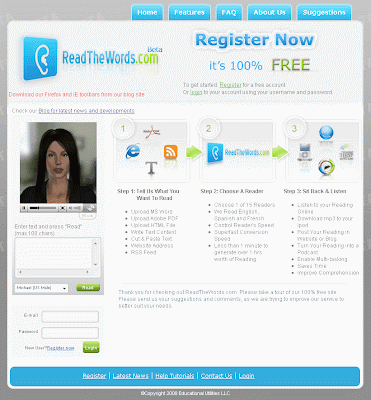
Many student learn by listening. They like to have information read to them. There's a nifty resource that this group of individuals will most assuredly want to explore. It's a free site designed to supply learners with new ways of processing written information. Known as ReadTheWords, it's a web-based tool for learning that employs Text To Speech (TTS) technology. Visitors to the site can generate a pretty impressive audio file from just about any kind of written material (for example, text taken from any Microsoft office document, Adobe PDF, txt file, or HTML document). Users supply the content and, after choosing a designated reader--the site has 15 to choose from--ReadTheWords generates a voice that reads the words aloud.


To begin using this resource, register for an account.
After registering, log in.

After successfully logging in, click on the CREATE A NEW READING button.

Give the new recording a title.

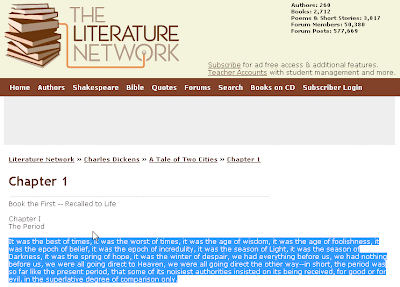
Grab some text to be read. In this case, I'm visiting The Literature Network where I've copied a chunk of the introductory chapter of one of my favorite works, A Tale of Two Cities by Charles Dickens.


Afterward, return to ReadTheWords, and paste the text into the INPUT TEXT box.

As some TTS readers are too fast for many listeners, ReadTheWords makes it possible for users to slow their digital readers down a bit.

Want a British work of literature to be read by a British narrator? No problem! ReadTheWords allows users to choose a particular voice (such as Charles, a UK male).


Next, press the red READ button.

After the "recording" phase of the work is over, users see a screen that allows them to play the recorded text.

Note that users may also download an mp3 file of the text.

This is something that makes all of the effort worthwhile. Why? Notes, words from a webpage, words from any file where copying text is possible can be converted into an mp3 file. The resulting mp3 file can be loaded on an iPod or any other mp3 player. Information taht was once locked up in text can be listened to anytime the user wishes to reconnect with it. This resource gives students another means of accessing and processing content.

Yes, the voice is not a natural human voice. It does sound somewhat robotic. That said, this service is free. For many pupils who learn by listening, ReadTheWords is a no-cost way of drawing upon the strength of their particular learning style.

Thursday, September 18, 2008

Let Me See What's On Your Mind

Recently, an elementary Language Arts teacher asked me if I knew of any good, free resources for helping her students generate cognitive maps. She was particularly interested in any resource that didn't require downloading and/or installation of software. Without missing a beat I suggested she check out Text2MindMap, a web-based resource that quickly converts text outlines into pretty spiffy mind maps. All a user has to do is create an outline in the box on the screen and click the CONVERT TO MIND MAP button. That's it!

What makes this resource so handy is that it can be used beyond the Language Arts classroom, any place where an outline is being explored. For example, if, in a Science classroom, a group of students are discussing the structure of the Solar System, an outline could be generated and typed in the box.

After a general consensus about the information, the students click the CONVERT TO MIND MAP BUTTON.
Within a few seconds, the group of students has a mind map of the topic.

The group can tinker with the mind map by working with the CONTROLS features.
Best of all, the mind map can be SAVED and used offline!
A click of the SAVE MAP button yields a jpg image that can be used in a slideshow or word processing document.


Why not have your students check out and use this snappy tool for learning?

Wednesday, September 17, 2008

Know Your Rights: Constitution Day


On September 17th, 1787, attendees at the U.S. Constitutional Convention made history by signing the one of the most important documents in the world. Now, some 221 years later, America proudly recognizes the ratification of the United States Constitution (as well as all individuals who've become citizens by either coming of age or through the process of naturalization). Today is Constitution Day. Does this matter to your students? Do they know their rights? How informed are they about their liberties? Integrate a little technology: listen to a digital audio recitation of the Constitution as read by David P. Currie, the Edward H. Levi Distinguished Service Professor Emeritus of University of Chicago Law School.

Essential questions related to this topic:
  • What's the best/worst way to interpret the Constitution?
  • Is the Constitution the best means of resolving the struggle between security and liberty?
  • What (if anything) is the most important reason to understand or support the continued use of the Constitution?
  • How can the Constitution be improved?
  • What's the best evidence of the power of the Constitution?
  • What is the most good the Constitution has done for any individual in the history of our nation?
  • What is the weakest part of the Constitution?
  • What is the single, most important right insured by the Constitution?
  • What is the most compelling reason to deny and/or suspend an individual's or group's rights as guaranteed by the Constitution? Should these rights ever be suspended?
  • Which individual is the epitome of the ideals expressed in the Constitution (i.e., who is a role model for the ideals expressed in the document)?
  • How can/could the Constitution be reworded so as to express the same (or even more noble) ideals for a larger audience?

Related links:

Tuesday, September 16, 2008

Braving the Elements

For students who are beginning to explore the complexities of matter, an introduction to the subtleties of the Periodic Table of Elements can be something of a revelatory experience, akin to finding an operating manual for atoms. The Periodic Table is a valuable tool for understanding reveals the underlying architechure of matter and prepares novices for a better grasp of the principles of chemistry. Rather than relegating pupils to textbooks when it comes to exploring the elements, encourage learners to make use of web-based sources of information. Take, for example, the Dynamic Periodic Table. Although it contains much the same information found in an exhaustive textbook, the information is much easier to access.

Want to immediately grab the attention of students? Swing by Parallel Graphic's eye-popping 3D Periodic Table. This resource is great when combined with an interactive whiteboard or slate. Note: you'll need to use Internet Explorer and download Cortona, a 3D viewer for IE. The effort will will be well worth it.

By integrating hyperlinked, multimedia-rich resources, students are more likely to discover opportunities for creating meaningful associations between the material being learned and their own experiences. To make in-roads to learning, consider exposing learners to image-rich resources. Want proof? If so, simply look up the work of Theodore Gray, one of the founders of Wolfram Research (creators of the awe-inspiring Mathematica). Gray is also a columnist for Popular Science’s Gray Matter and an element collector extraordinaire who has crafted an exquisite Periodic Table of the Elements. His craftsmanship and obsession with elements makes his version of the Periodic Table a veritable feast for the eyes that learners and instructors are sure to enjoy.

In the same vein, the Periodic Table of Videos provided by the University of Nottingham moves users beyond mere words and dishes up engaging images that stick in the mind longer after vistors leave the web.


Essential questions related to this topic:
  • What is the most (or least important) element on the Periodic Table?
  • What is the best/most truthful way to explain the structure of matter? For example, what's the best way to create models of something we can’t see--like atoms?
  • In what ways can the current Periodic Table be significantly improved for younger and/or non-scientific users?
  • Is the natural world significantly affected by the actions of individuals/societies who don't know or care about the Periodic Table? In other words, what so important about this bit of science that makes it worth learning?
  • What universal rules govern matter and its processes?
  • Which is more important matter or energy?
  • Why exactly should scientists bother getting information about something as small as electrons in atoms?
  • What's the most important reason for the way the Periodic Table is organized the way it is? Given advancements in technology, what might make it possible for future scientists to rewrite the rules for the way the Period Table is organized?

Related Links:

Monday, September 15, 2008

All Together Now: International Day of Democracy


By combining a couple of Greek root words (demos meaning "the people," and kratein which means "to rule") we get a vocabulary term that describes an idea that originated in the Aegean world. That term is democracy. Government by the people was (and, in some places, continues to be) viewed as a revolutionary idea. Acknowledging the resilience and universality of the principles of democracy, the United Nations has declared today-- the 15th of September--the International Day of Democracy.

Essential questions (as described by Grant P. Wiggins and Jay McTighe in their book Understanding by Design) are the "big ideas" wrapped up in questions that humans continue to ponder over the course of a lifetime. Such questions lack easy answers. They can be used to engage students and encourage them to seriously ponder the core or the essence of a topic being studied. Essential questions are extremely useful in revealing what pupils think about a topic. A few such questions related to the topic of democracy are listed below. What follows is by no means an exhaustive list.
  • Why do we need government?
  • Why can't we just all agree?
  • What gives anyone--whether a person or group--the authority to decide for others?
  • What is the absolute best/worst form of government?
  • Will humans ever design a sustainable, humane form of government? If so, why, how, where or when?
  • What are the most important factors to consider when constructing any form of government?
  • Who is most qualified to be our leader?
  • What is the best (i.e., equitable, efficient, effective, lasting, et cetera) way to improve democracy (or other forms of government)?
  • Should there be one form of government that all humans should abide by?
  • Is a lack of government (i.e., peaceful anarchy) possible?
  • When do (or should) the needs of the many trump the rights of the individual?
  • What are the characteristics of an active citizen?
  • How is it possible for everyone in a society to retain the greatest amount of autonomy (individual freedom) and still enjoy the benefits of government?
  • What methods of political action promote or inhibit change?
  • Is democracy the best form of government or an outdated idea?

Related links:

Friday, September 12, 2008

Get in the Zone...the NGAkids Art Zone!


These days, many administrators and educators are finally beginning to realize the value of art in learning. It's about time, too! Constructing learning experiences in which pupils are allowed and expected to be academically and artistically creative is a wise investment in improving education. For example, check out the National Gallery of Art's wildly interactive NGAkids Art Zone. It's a wonderfully robust resource where adults and students can spend time exploring the site’s excellent tools. They are specifically designed for creating online art. When combined with innovative approaches to education and interactive whiteboards like those produced by GTCO, Promethean, and SMARTBoard, learning becomes fun--almost addictive! In addition to the excellent online resources available at the National Gallery of Art is the institution's NGA Classroom (complete with featured lessons) and an Art Loan Program.